
The short answer
A cat’s tag has one job: get whoever finds them to call you. Everything below comes back to four decisions.
- Engrave the essentials — your cat’s name and a phone number you actually answer, on a tag small and light enough for a cat.
- Put it on a breakaway collar — the quick-release clip that lets a snagged cat free itself is not optional for cats the way it can be for dogs.
- Do not skip it for an indoor cat — indoor cats are often the very ones who bolt, and the least streetwise when they do.
- Keep the microchip current — the chip is only as good as the registration record sitting behind it.
What to engrave
A cat’s tag is smaller than a dog’s, and that is a feature, not a limitation — it forces the text down to what actually matters. Whoever reads it will likely be a neighbour crouched by a fence with a wary cat a metre away, so it needs to work at a glance.
Put on
- Your cat’s name — the one they actually answer to (sometimes).
- A phone number you answer, ideally a mobile.
- A second number, or a short “I am chipped”, on the back of a double-sided tag if you want the extra room.
Leave off
- Your home address — a lost-cat tag is read by strangers.
- Long or fussy text that shrinks to fit and stops being legible.
- Details that change often, so the tag stays accurate for years.
Because every Red Dingo tag is deep diamond engraved — cut into the metal rather than printed on top — even a small cat tag stays exactly as legible in five years as it is on day one. If you are unsure which size suits your cat, our size guide walks you through it: for cats, the answer is nearly always the small, light option.
The breakaway collar rule
Cats climb, squeeze and jump in a way dogs simply do not, and a collar that cannot release under pressure is a genuine hazard for them. A breakaway (quick-release) collar solves this: if the collar snags on a branch, a fence paling or a gap, the clip pops open and your cat frees itself. Fitted correctly — snug enough for two fingers to slide underneath, no more — it stays on through normal daily wear and only releases when it genuinely needs to.
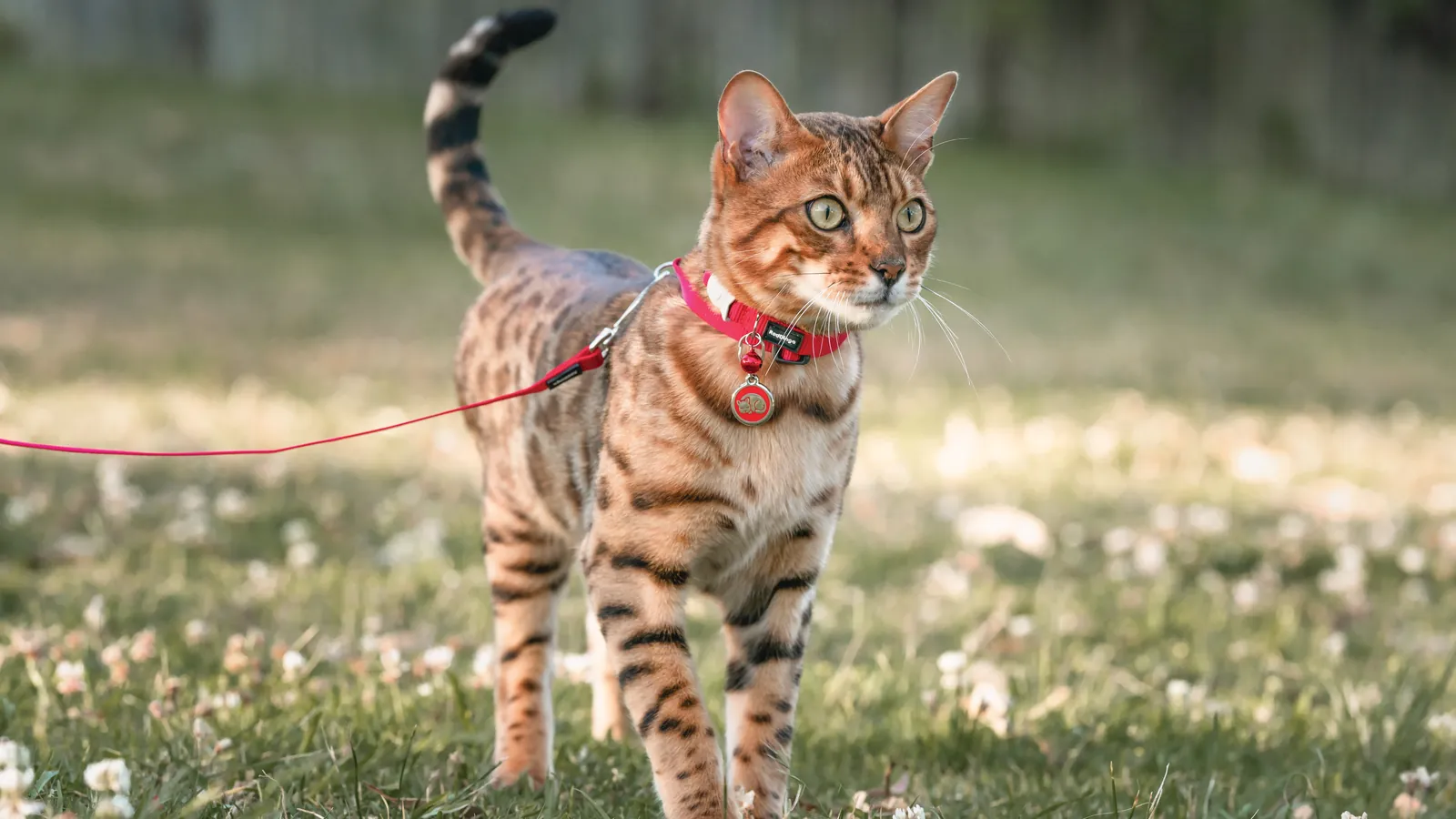
The tag’s job is to be so small and light that the collar barely notices it is there. That is the whole strategy for cat ID: a breakaway collar for safety, a light engraved tag for the on-the-spot phone call, and a microchip behind both as the permanent backup. We cover collar fit and cat safety in more depth in keeping your cat safe: collars, breakaway clips and ID.
Indoor cats need ID too
It is tempting to think an indoor cat does not need a collar and tag. But indoor cats slip out more often than owners expect — a door propped open for the shopping, a window screen that gives way, a fright during a storm — and an indoor cat outside is far less streetwise than one used to roaming. They tend to hide close to home, scared and silent, and the person most likely to spot them is a neighbour, not a shelter.
That neighbour cannot scan a microchip. They can read a tag and phone you on the spot, which is usually the difference between a same-day reunion and a week of letterbox flyers. With more Australian councils moving toward cat containment and curfew rules, an “inside cat” is increasingly the normal cat — and visible ID matters more for them, not less.
Keep the microchip details current
Most Australian states and territories require cats to be microchipped, and a chip is a wonderful permanent backup — it cannot snag, fall off or wear out. But a chip is only as useful as the registration record behind it. A vet or shelter can scan your cat in seconds; if the phone number on file is years out of date, the scan is a dead end.
- Update your details on the registry straight after you move house.
- Update them again the moment your phone number changes.
- If you rehome, adopt or take in a cat, confirm the registration is transferred to you.
- Do a quick check once a year regardless — it takes a couple of minutes and closes a gap you might not otherwise notice.
Tag and chip are a team with different jobs. The tag is read on the spot by whoever finds your cat, with no equipment at all. The chip is the fallback if the collar has released or the tag is lost — but only if the record behind it is current.
The little things that matter
We only sell genuine Red Dingo tags, made to last and backed by a lifetime guarantee — and your rights under the Australian Consumer Law are unaffected either way. Engraving is included, delivery is free worldwide, and there is one small touch we love: Red Dingo personalises the delivery envelope with your cat’s name, so the parcel that lands on your doorstep already feels like it belongs to them.
Ready to put this into practice? Preview your cat’s exact engraving in the customiser, or browse the cat tags range to find a design they will barely notice they are wearing.
Common questions
- What should I engrave on a cat’s ID tag?
- Your cat’s name and a phone number you actually answer. A cat tag is small, so keep it to the essentials — a second number or a short note like “I am chipped” fits nicely on the back of a double-sided tag. Leave your home address off, since a lost-cat tag is read by strangers.
- Do indoor cats need an ID tag?
- Yes. Indoor cats slip out more often than owners expect — an open door, an open window, a fright — and an indoor cat outside is far less streetwise than one used to roaming. A small tag with your number is the fastest way for whoever finds them to call you, and it pairs with the microchip as a backup.
- Should a cat still wear a tag if it is microchipped?
- Yes — they do different jobs. A microchip is the permanent backup, but it needs a vet or shelter with a scanner and a current registration to help. An engraved tag lets a neighbour or passer-by phone you on the spot, without any equipment at all. The two together give your cat the best chance of a quick trip home.
- What size tag is best for a cat?
- A small, light one. Cats notice weight far more than dogs, so a smaller tag sits more comfortably and is less likely to bother them. It still has room for a name and a phone number deep diamond engraved into it — legibility does not depend on size. Our size guide can help you pick.
- Does my cat need a breakaway collar for a tag?
- A breakaway or quick-release collar is the safest choice for a cat. If the collar snags on a branch or fence, the clip releases so your cat can free itself. A correctly fitted one still stays on through normal everyday wear, and a small, light tag sits happily on it — so there is no need to choose between safety and ID.