
The short answer
Both methods put readable text on a tag. The difference is where that text lives.
- Deep diamond engraving is cut into the metal — a diamond-tipped cutter carves each character down into the tag, leaving a groove with real depth.
- Laser engraving sits on the surface — a beam discolours or lightly etches the top of the metal, producing a mark rather than a groove.
- On a pet tag, depth is what lasts — a tag takes daily knocks for years, and text with depth stays readable as the surface wears.
Two very different ways to put text on metal
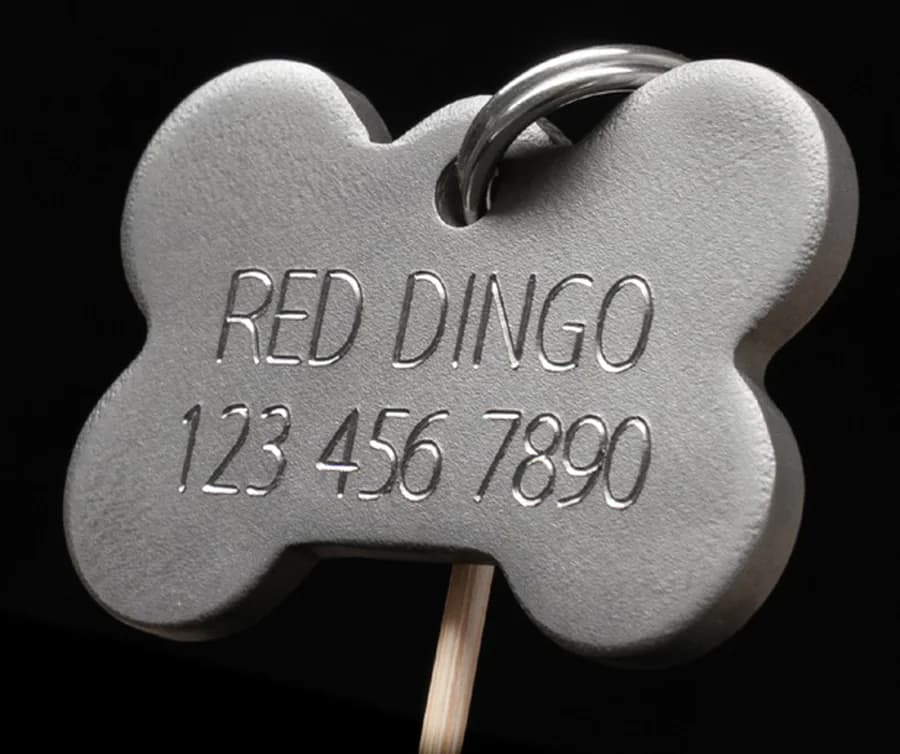
Deep diamond engraving is the traditional, mechanical method: a diamond-tipped cutter is driven along the path of each character, physically carving it down into the metal. Run a fingernail across a Red Dingo tag and you can feel the result — every letter and digit is a genuine groove, not a printed layer or a surface tint. The text is part of the tag itself.
Laser engraving — more accurately laser marking or etching, on most pet tags sold under that name — works entirely differently. A focused beam heats the surface of the metal to discolour it, or ablates away a very thin layer. It is fast, cheap and precise, which is why it is everywhere, and the result looks crisp on day one.
For something that sits still on a shelf, that is fine. A pet tag does the opposite of sitting still. It swings against food bowls, scrapes along footpaths and rubs against the collar and buckle with every step. Give a shallow surface mark that kind of daily abrasion and, over time, it wears toward smooth — and a number you cannot read is a number nobody can call.
Side by side
| Deep diamond engraving | Laser engraving | |
|---|---|---|
| How the text is made | Cut deep into the metal with a diamond tip | Marked on or near the surface with a beam |
| Depth | A real groove you can feel | Shallow surface mark |
| Legibility after years of wear | Stays readable as the surface wears | More likely to fade toward smooth |
| Best suited to | A tag that must survive daily abrasion for years | Fast, low-cost marking where wear is not a factor |
None of this makes laser marking a bad technology — it is the right tool for plenty of jobs. It just is not the right tool for the one job a pet tag has to do, which is to stay readable through years of knocks so a stranger can always call you.
Why depth matters more on a tag than almost anything else
Think about when a tag actually earns its keep. It is not on the day you buy it — it is years later, on the day your dog slips the gate or your cat bolts through an open door. The person who finds them will be reading a tag that has been worn every day since: rattled against a water bowl, dunked at the beach, rubbed by the collar through thousands of walks. That is the moment the engraving has to still be legible at a glance.
Because deep diamond engraving leaves a genuine groove, wear works differently. As the surface of the tag picks up the scuffs and polish of daily life, the text remains — it is below the surface, not on it. A shallow surface mark has no such reserve: once the top layer wears, the text goes with it.
That is why every tag we sell is a genuine Red Dingo tag with deep diamond engraving included, backed by Red Dingo’s lifetime guarantee — and your rights under the Australian Consumer Law are unaffected either way. It is also worth keeping the text itself simple: our guide to what to put on a dog ID tag covers what belongs on there and what to leave off, so the deep-cut text stays easy to read at a glance.
Want to see how your own text will sit on a tag? Preview the exact engraving in the customiser, or browse the full range to find a design first.
Common questions
- Does laser engraving fade on a pet tag?
- It can. Most “laser engraved” pet tags are laser-marked or lightly etched — the mark sits on or just below the surface. On a tag that is knocked against bowls, dragged along footpaths and rubbed by the collar every day, a shallow surface mark wears smooth far sooner than text that is cut deep into the metal.
- Is deep diamond engraving the same as laser engraving?
- No. Deep diamond engraving uses a diamond-tipped cutter to physically carve each character down into the metal, leaving a groove with real depth. Laser engraving uses a beam to discolour or lightly ablate the surface. Both produce readable text on day one; the difference shows years later, once the tag has taken a beating.
- Will the engraving wear off my dog or cat’s tag?
- Any marking wears with use, but depth is what buys you years. Because deep diamond engraving is cut into the metal rather than printed or marked on top, the text stays legible as the surface wears — there is a real groove there, not just a mark. That is exactly why we use it on every Red Dingo tag.
- Can stainless steel be engraved deeply?
- Yes. A diamond-tipped cutter carves cleanly into stainless steel and brass, which is what gives a Red Dingo tag its depth and its long life. The hard-wearing metal and the deep cut work together: a tough tag with text cut deep enough to outlast the daily knocks.
- Is deep engraving better for an outdoor or working dog?
- It is well suited to it. The harder a tag’s life — mud, water, rough ground, constant movement — the more a shallow surface mark is likely to wear, and the more depth earns its keep. Deep diamond engraving gives an active dog’s tag the best chance of still being readable when it matters most.