The short answer
A dog’s tag has one job: get a stranger to call you. Everything below comes back to three decisions.
- Engrave the basics well — your dog’s name and a phone number you actually answer, kept simple and legible.
- Decide on a QR or smart tag with your eyes open — genuinely useful for some owners, but it comes with a real privacy and reliability trade-off worth understanding first.
- Keep the microchip current — the chip is only as good as the registration record sitting behind it.
Engraving best practice
Clarity beats cramming everything on. A tag is read at a glance, often by someone crouched on a footpath with a nervous dog in front of them, so the text needs to work instantly.
Put on
- Your dog’s name — the one they actually respond to.
- A phone number you answer, ideally a mobile.
- A second number, or a short “reward if found”, on the back of a double-sided tag if you want the extra room.
Leave off
- Your home address — a lost-dog tag is read by strangers.
- Long or fussy text that shrinks to fit and stops being legible.
- Details that change often, so the tag stays accurate for years.
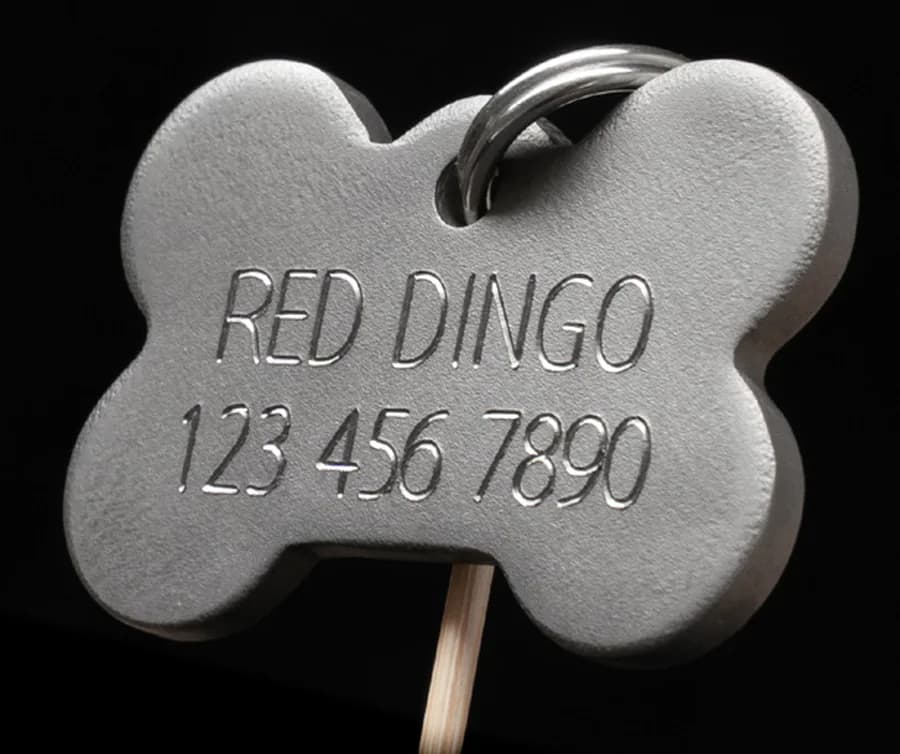
Because every Red Dingo tag is deep diamond engraved — cut into the metal rather than printed on top — the text stays exactly as legible in five years as it is on day one.
What about QR code and smart tags?
QR and NFC “smart” tags have become a common sight in pet shops: a code or chip that a finder scans with a smartphone to open an online profile with your details. They are a genuinely useful idea for some owners, but the convenience comes with a real trade-off that is worth weighing honestly rather than assuming one option is simply better.
| Deep-engraved tag | QR / NFC smart tag | |
|---|---|---|
| Works for any finder | Yes — readable instantly by anyone | Only with a charged smartphone and signal |
| Privacy | You choose exactly what is visible, always | The linked profile is visible to anyone who scans it, not just a genuine finder |
| Editable later | Only by re-engraving | Yes — update the profile any time |
| Depends on | Nothing — no battery, app or server | A working phone, and the provider’s service staying online |
If you do use a QR or smart tag, treat the linked profile like a public webpage rather than a private note: put your dog’s name, a phone number and any essential medical notes on it, and leave your home address and daily routine off, since it is visible to anyone who scans the code, not only whoever finds your dog. For most owners, the sturdiest approach is a deep-engraved tag as the reliable core — it needs no phone, no app and no signal to work — with a QR tag as an optional extra rather than a replacement for it.
Keep the microchip details current
Most Australian states and territories require dogs to be microchipped, and a chip really is a wonderful permanent backup — it cannot fall off or wear out. But a chip is only as useful as the registration record behind it. A vet or shelter can scan your dog in seconds, but if the phone number or address on file is years out of date, the scan is a dead end.
- Update your details on the registry straight after you move house.
- Update them again the moment your phone number changes.
- If you rehome, adopt or take in a dog, confirm the registration is transferred to you.
- Do a quick check once a year regardless — it takes a couple of minutes and closes a gap you might not otherwise notice.
Think of the two as a team with different jobs. The tag is read on the spot by whoever finds your dog, with no equipment at all — that is why it is worth getting the engraving right. The chip is the fallback if the tag is ever lost, but only if the record behind it is current.
The little things that matter
We only sell genuine Red Dingo tags, made to last and backed by a lifetime guarantee — and your rights under the Australian Consumer Law are unaffected either way. Engraving is included, delivery is free worldwide, and there is one small touch we love: Red Dingo personalises the delivery envelope with your dog’s name, so the parcel that lands on your doorstep already feels like it belongs to them.
Ready to put this into practice? Preview your dog’s exact engraving in the customiser, or browse the dog tags range and our size guide if you are still deciding on a size.
Common questions
- What should I engrave on a dog’s ID tag?
- Your dog’s name and a phone number you actually answer. A second number helps if you have one, and a double-sided tag gives you a second face for extra detail. Leave your home address off — a lost-dog tag is read by strangers — and keep the text simple so it stays legible at a glance.
- Are QR code dog tags better than an engraved tag?
- They solve different problems. A QR or NFC tag can carry more detail and lets you update it without buying a new tag, but it only works for a finder with a charged smartphone, signal or an app, and whatever is on the linked profile is visible to anyone who scans it, not only a genuine finder. An engraved tag needs none of that — it works for absolutely anyone, instantly. Most owners are best served by a deep-engraved tag as the reliable core, with a QR tag as an optional extra rather than a replacement.
- Is it safe to put my address on a QR code tag profile?
- Treat a linked profile like a public webpage, not a private note to a finder — anyone who scans the tag can see it, not just whoever finds your dog. Keep it to a name, a phone number and any essential medical notes, and leave your home address and daily routine off.
- How often should I update my dog’s microchip details?
- Straight away after moving house, changing your phone number, or a change of ownership, and then a quick check once a year regardless. A microchip is only as useful as the registration record behind it — an out-of-date record can be as good as no chip at all.
- Do I still need an engraved tag if my dog is microchipped?
- Yes — the two work together, not instead of each other. A microchip is the permanent backup, but it needs a vet or shelter with a scanner and a current registration to be useful. An engraved tag lets whoever finds your dog phone you straight away, which is usually the fastest way home.